- Phone: +39 0331 642232
- Email: mail@fantinelli.it

FANTINELLI Srl
Solid front pressure gauges S3
HOME | PRODUCTS | PRESSURE GAUGES | SOLID FRONT PRESSURE GAUGES S3 | SF 317
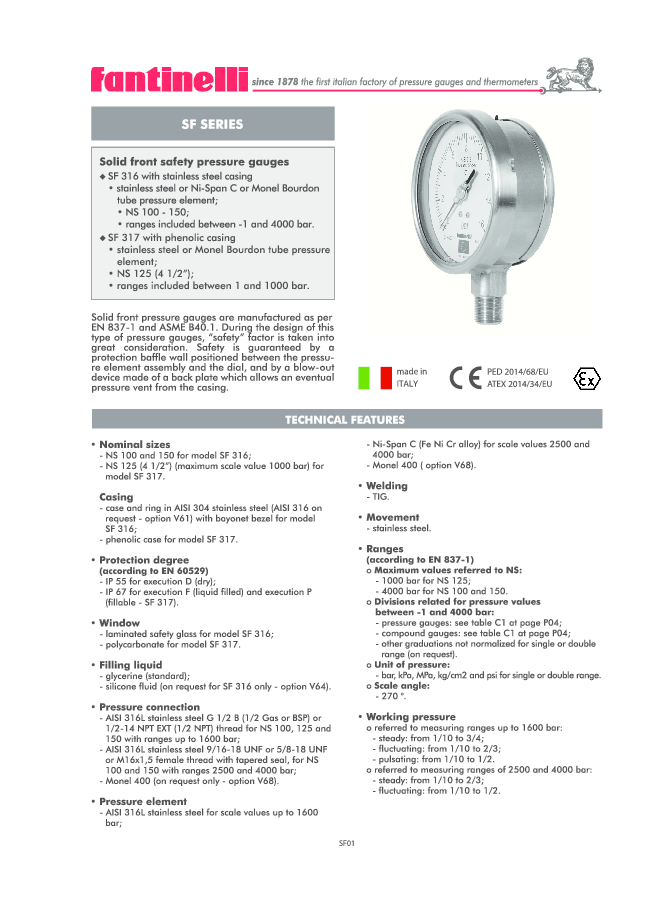
Solid front pressure gauge with bottom connection for local or surface mounting SF 317

• Nominal sizes
- NS 100 and 150 for model SF 316;
- NS 125 (4 1/2”) (maximum scale value 1000 bar) for model SF 317.
• Casing
- case and ring in AISI 304 stainless steel (AISI 316 on request - option V61) with bayonet bezel for model SF 316;
- phenolic case for model SF 317.
• Protection degree (according to EN 60529)
- IP 55 for execution D (dry);
- IP 67 for execution F (liquid filled) and execution P (fillable - SF 317).
• Window
- laminated safety glass for model SF 316;
- polycarbonate for model SF 317.
• Filling liquid
- glycerine (standard);
- silicone fluid (on request for SF 316 only - option V64).
• Pressure connection
- AISI 316L stainless steel G 1/2 B (1/2 Gas or BSP) or 1/2-14 NPT EXT (1/2 NPT) thread for NS 100, 125 and 150 with ranges up to 1600 bar;
- AISI 316L stainless steel 9/16-18 UNF or 5/8-18 UNF or M16x1,5 female thread with tapered seal, for NS 100 and 150 with ranges 2500 and 4000 bar;
- Monel 400 (on request only - option V68).
• Pressure element
- AISI 316L stainless steel for scale values up to 1600 bar;
- di Ni-Span C (lega Fe Ni Cr) per valori di fondo scala 2500 e 4000 bar;
- di Monel 400 (variante V68).
- Ni-Span C (Fe Ni Cr alloy) for scale values 2500 and 4000 bar;
- Monel 400 ( option V68).
• Welding
- TIG.
• Movement
- stainless steel.
• Ranges (according to EN 837-1)
o Maximum values referred to NS:
- 1000 bar for NS 125;
- 4000 bar for NS 100 and 150.
o Divisions related for pressure values between -1 and 4000 bar:
- pressure gauges: see table C1 at page P04;
- compound gauges: see table C1 at page P04;
- other graduations not normalized for single or double range (on request).
o Unit of pressure:
- bar, kPa, MPa, kg/cm2 and psi for single or double range.
o Scale angle:
- 270 °.
• Working pressure
o referred to measuring ranges up to 1600 bar:
- steady: from 1/10 to 3/4;
- fluctuating: from 1/10 to 2/3;
- pulsating: from 1/10 to 1/2.
o referred to measuring ranges of 2500 and 4000 bar:
- steady: from 1/10 to 2/3;
- fluctuating: from 1/10 to 1/2.
• Over-pressure (occasionally allowed)
- 130% of full scale value for measuring ranges up to 1600 bar (standard);
- 160% of full scale value for measuring ranges up to 60 bar (option V25);
- 250% of full scale value for measuring ranges up to 60 bar (option V27);
- not allowed for measuring ranges 2500 and 4000 bar.
• Pointer
- aluminium with micrometer adjustment for dry execution;
• Dial
- white aluminium with black figures (for dial modifications see available options).
• Accuracy (secondo EN 837-1)
o SF 316:
- class 1 (± 1% of full scale deflection) standard;
- class 0,6 o 0,5 (± 0,6 o 0,5% of full scale deflection) on request - option V36 o V34 (full scale 4000 bar excluded).
o SF 317:
- class 0,5 (± 0,5% of full scale deflection) standard (according to BS and ANSI).
• Ambient temperature
- -40 ÷ +60 °C dry execution;
- -20 ÷ +60 °C glycerine filled execution;
- -40 ÷ +60 °C silicone fluid filled execution.
• Thermal drift
- out of optimum ambient temperature values included within +15 ÷ +25 °C, the thermal drift affects the instruments accuracy of 0,3% every 10 °C.
• Operating temperature
- -40 ÷ +250 °C dry execution;
- -20 ÷ +100 °C glycerine filled execution;
- -40 ÷ +120 °C silicone fluid filled execution.
note: 80 °C maximum operating temperature for glycerine filled instruments, 120 °C for silicone fluid filled ones.
Solid front safety pressure gauges
SF 316 with stainless steel casing
- stainless steel or Ni-Span C or Monel Bourdon tube pressure element;
- NS 100 - 150;
- ranges included between -1 and 4000 bar.
SF 317 with phenolic casing
- stainless steel or Monel Bourdon tube pressure element;
- NS 125 (4 1/2”);
- ranges included between 1 and 1000 bar.
Solid front pressure gauges are manufactured as per EN 837-1 and ASME B40.1. During the design of this type of pressure gauges, “safety” factor is taken into great consideration. Safety is guaranteed by a protection baffle wall positioned between the pressure element assembly and the dial, and by a blow-out device made of a back plate which allows an eventual pressure vent from the casing.

• Nominal sizes
- NS 100 and 150 for model SF 316;
- NS 125 (4 1/2”) (maximum scale value 1000 bar) for model SF 317.
• Casing
- case and ring in AISI 304 stainless steel (AISI 316 on request - option V61) with bayonet bezel for model SF 316;
- phenolic case for model SF 317.
• Protection degree (according to EN 60529)
- IP 55 for execution D (dry);
- IP 67 for execution F (liquid filled) and execution P (fillable - SF 317).
• Window
- laminated safety glass for model SF 316;
- polycarbonate for model SF 317.
• Filling liquid
- glycerine (standard);
- silicone fluid (on request for SF 316 only - option V64).
• Pressure connection
- AISI 316L stainless steel G 1/2 B (1/2 Gas or BSP) or 1/2-14 NPT EXT (1/2 NPT) thread for NS 100, 125 and 150 with ranges up to 1600 bar;
- AISI 316L stainless steel 9/16-18 UNF or 5/8-18 UNF or M16x1,5 female thread with tapered seal, for NS 100 and 150 with ranges 2500 and 4000 bar;
- Monel 400 (on request only - option V68).
• Pressure element
- AISI 316L stainless steel for scale values up to 1600 bar;
- di Ni-Span C (lega Fe Ni Cr) per valori di fondo scala 2500 e 4000 bar;
- di Monel 400 (variante V68).
- Ni-Span C (Fe Ni Cr alloy) for scale values 2500 and 4000 bar;
- Monel 400 ( option V68).
• Welding
- TIG.
• Movement
- stainless steel.
• Ranges (according to EN 837-1)
o Maximum values referred to NS:
- 1000 bar for NS 125;
- 4000 bar for NS 100 and 150.
o Divisions related for pressure values between -1 and 4000 bar:
- pressure gauges: see table C1 at page P04;
- compound gauges: see table C1 at page P04;
- other graduations not normalized for single or double range (on request).
o Unit of pressure:
- bar, kPa, MPa, kg/cm2 and psi for single or double range.
o Scale angle:
- 270 °.
• Working pressure
o referred to measuring ranges up to 1600 bar:
- steady: from 1/10 to 3/4;
- fluctuating: from 1/10 to 2/3;
- pulsating: from 1/10 to 1/2.
o referred to measuring ranges of 2500 and 4000 bar:
- steady: from 1/10 to 2/3;
- fluctuating: from 1/10 to 1/2.
• Over-pressure (occasionally allowed)
- 130% of full scale value for measuring ranges up to 1600 bar (standard);
- 160% of full scale value for measuring ranges up to 60 bar (option V25);
- 250% of full scale value for measuring ranges up to 60 bar (option V27);
- not allowed for measuring ranges 2500 and 4000 bar.
• Pointer
- aluminium with micrometer adjustment for dry execution;
• Dial
- white aluminium with black figures (for dial modifications see available options).
• Accuracy (secondo EN 837-1)
o SF 316:
- class 1 (± 1% of full scale deflection) standard;
- class 0,6 o 0,5 (± 0,6 o 0,5% of full scale deflection) on request - option V36 o V34 (full scale 4000 bar excluded).
o SF 317:
- class 0,5 (± 0,5% of full scale deflection) standard (according to BS and ANSI).
• Ambient temperature
- -40 ÷ +60 °C dry execution;
- -20 ÷ +60 °C glycerine filled execution;
- -40 ÷ +60 °C silicone fluid filled execution.
• Thermal drift
- out of optimum ambient temperature values included within +15 ÷ +25 °C, the thermal drift affects the instruments accuracy of 0,3% every 10 °C.
• Operating temperature
- -40 ÷ +250 °C dry execution;
- -20 ÷ +100 °C glycerine filled execution;
- -40 ÷ +120 °C silicone fluid filled execution.
note: 80 °C maximum operating temperature for glycerine filled instruments, 120 °C for silicone fluid filled ones.
Solid front safety pressure gauges
SF 316 with stainless steel casing
- stainless steel or Ni-Span C or Monel Bourdon tube pressure element;
- NS 100 - 150;
- ranges included between -1 and 4000 bar.
SF 317 with phenolic casing
- stainless steel or Monel Bourdon tube pressure element;
- NS 125 (4 1/2”);
- ranges included between 1 and 1000 bar.
Solid front pressure gauges are manufactured as per EN 837-1 and ASME B40.1. During the design of this type of pressure gauges, “safety” factor is taken into great consideration. Safety is guaranteed by a protection baffle wall positioned between the pressure element assembly and the dial, and by a blow-out device made of a back plate which allows an eventual pressure vent from the casing.
